Attic Air Handlers: The Ceiling Stain That Starts With a Drain Pan
The unit doing the real work in most Magnolia-area homes is hidden in the attic, and it's built around one small problem: water.
August 25, 2026 · 4 min read
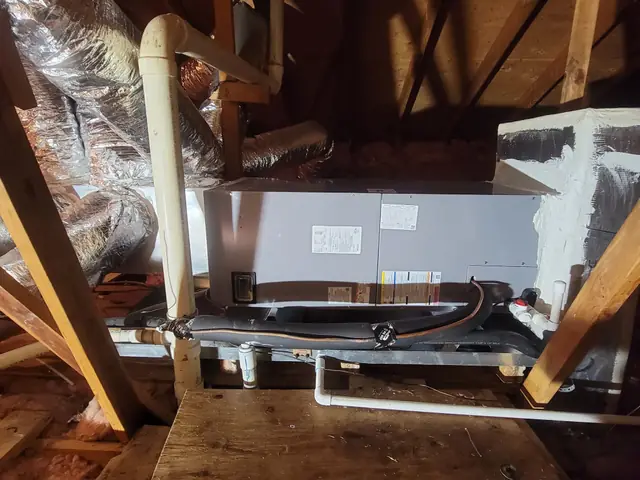
Walk into most attics in Magnolia, Tomball or Spring and you'll find the air handler up there, not in a closet or a garage. Slab-on-grade homes without basements push the indoor half of the AC system overhead, and that arrangement works fine for decades as long as one specific thing keeps working: the path the water takes out of the unit and away from the drywall underneath it.
Every cooling cycle makes water, on purpose
Pulling humidity out of the air is a real part of what an air conditioner does, not a side effect. As warm, humid attic and house air moves across the cold evaporator coil inside the air handler, water condenses on the coil's fins the same way it beads on a cold glass. That water drips into a drain pan directly under the coil and is supposed to run out through a condensate line, usually to the outside or into a floor drain below. On a humid Gulf Coast afternoon a system can pull several gallons of water out of a house's air over the course of a day. All of that has to leave the attic through a pipe roughly the width of a finger.
Why a secondary drain pan and float switch exist
Because that pipe can and does clog, most attic installs, including the ones JTech puts in, include a secondary drain pan set underneath the whole unit. If the primary line backs up and the main pan overflows, the secondary pan catches the overflow instead of letting it run straight through the ceiling into the room below. A float switch sits in that secondary pan, or sometimes in the primary line itself, and its job is simple: if water rises to a level that shouldn't happen, it opens the circuit and shuts the system down before it makes more water than the pan can hold.
That shutdown feels like a nuisance in the moment, a hot house on a July afternoon with the AC dead for no obvious reason, but it's doing exactly what it's supposed to do. The alternative is a slow drip that nobody notices until a brown ring shows up on a bedroom ceiling, by which point there's wet insulation, a stained ceiling, and sometimes drywall to repair on top of whatever caused the clog in the first place.
What actually clogs the line
Algae and biological sludge are the usual cause. A condensate line is dark, damp and slightly warm almost all the time in summer, which is close to ideal conditions for growth. Left alone for a couple of seasons, that buildup narrows the inside of the pipe until water backs up faster than it can drain, especially during the highest-humidity stretches when the system is producing the most condensate. This is exactly why flushing the drain line is part of a proper maintenance visit rather than something that only gets attention when there's already a problem.
- A ceiling stain, even a faint one, directly below or near an attic air handler
- A musty smell from a supply vent that wasn't there before
- The AC shutting off on its own with no error on the thermostat
- Visible water or staining in a secondary drain pan during an attic inspection
JTech installs attic air handlers as part of new system installs and replacements across the service area, and the crew wears protective coverings on their shoes during installs specifically because attic and indoor work happens inside someone's home. If a float switch has already tripped or a ceiling is showing a stain, that's worth a call rather than a wait, since the fix is usually straightforward but the damage from ignoring it isn't.
Insulation and the line set matter too
The refrigerant line running between the attic air handler and the outdoor condenser carries cold, low-pressure gas back toward the compressor, and that line sweats just like the coil does if it isn't insulated properly. A gap in that insulation, even a short stretch where foam wrap has torn or slipped, is enough to drip condensation onto attic insulation or the top of a ceiling joist over time. It's a smaller version of the same underlying issue as the drain pan: water finding its way somewhere it isn't supposed to go, quietly, in a part of the house nobody looks at from one year to the next.
This is also why an attic install is worth doing carefully the first time rather than treating it as a simple box swap. Getting the air handler level, supporting it properly rather than resting it directly on ceiling joists, running the drain line with enough slope to actually drain, and insulating every foot of exposed line set are all things that take an extra half hour during install and save a homeowner from a ceiling repair years down the road. JTech's crews wear protective shoe coverings during installs and treat attic work with the same care as anything visible in the living room, because the parts nobody sees are usually the ones that cause the most damage when they're done wrong.
JTech Mechanical, (281) 252-0360
Call (281) 252-0360More articles
Why Air Conditioners Fail in Montgomery County in August
The heat doesn't break your AC in a single afternoon. It finishes off a problem that's been building for weeks.
What Twice-a-Year AC Maintenance Actually Involves
Two visits a year, timed right, catch most of what turns into an August breakdown.